A book by Chris Perkins
BREAKTHE CHAIN
Defending at Machine Speed
Building resilience in the age of autonomous AI attacks.
Foreword by Chadwick Smith
126% funded on
Public release
Insert judgment
before impact
Cover art by MJ Gonzales, Book Design by Alan Hebel.
A book by Chris Perkins
Defending at Machine Speed
Building resilience in the age of autonomous AI attacks.
Foreword by Chadwick Smith
126% funded on
Insert judgment
before impact
Break the Chain follows the arc of a good response. It names the problem, designs the answer, shows you how to build it, and tells you where to start.
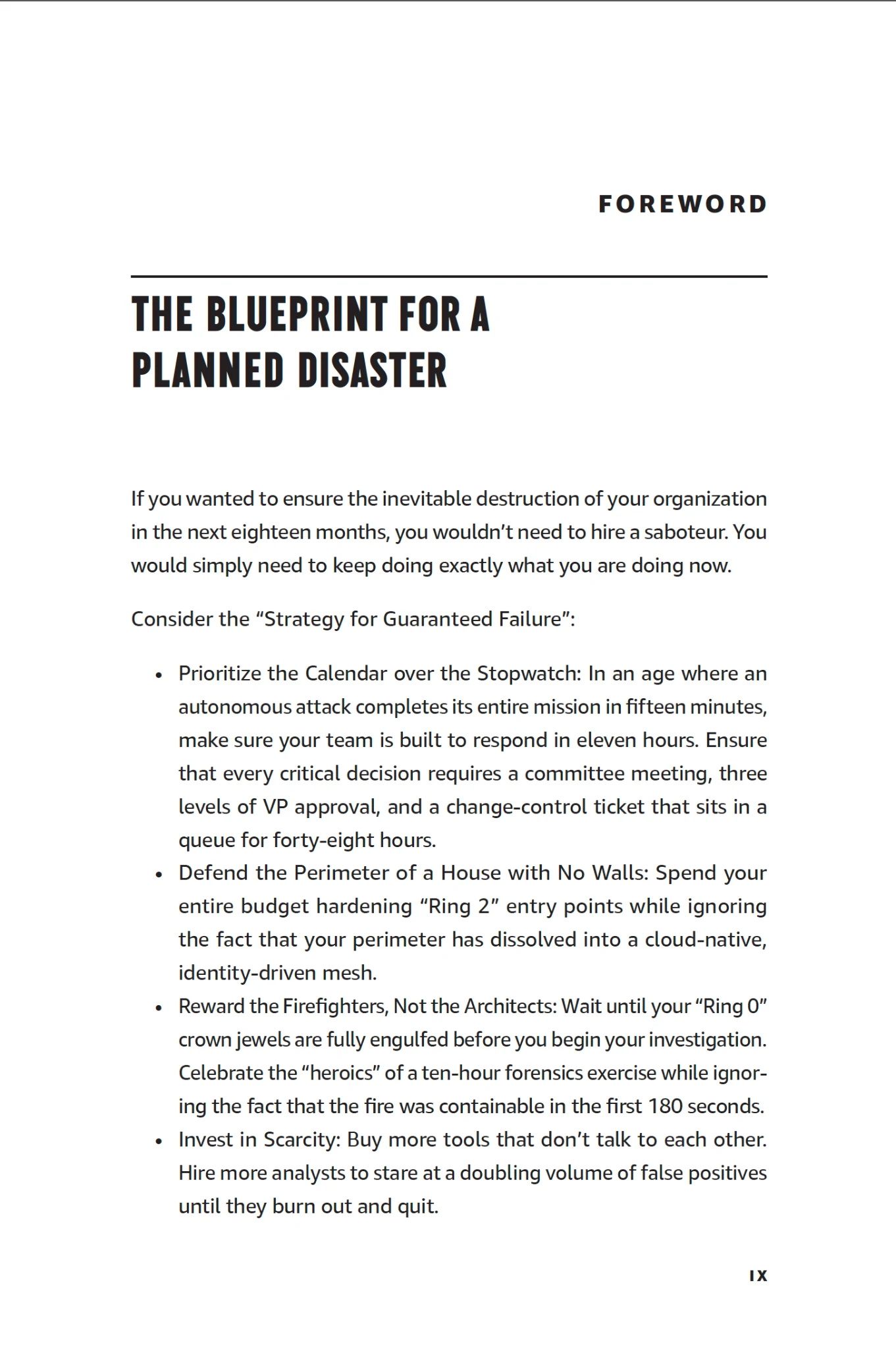
Tap the page to enlarge · Swipe or use the arrows to turn pages
I The four Parts · 1 of 4
“The words come first. Everything you build later depends on getting them right.”
Name the gap between fifteen-minute attacks and eleven-hour responses.
A shared vocabulary gives the team a common starting point.
Four phases reveal how the threat changes through 2030 and beyond.
A fifteen-minute attack breaks the defender’s familiar rhythm.
Knowing your own network gives you an advantage the attacker must earn.
Ten patterns make exponential change useful for Monday’s decisions.
Twenty years of breaches reveal a widening gap between tools and culture.
II The four Parts · 2 of 4
“Our digital fortresses are like sandcastles crumbling under the relentless tide of innovation.”
Replace static defenses with a continuously adapting Trust Mesh.
A single compromise can cascade across sixteen systems before triage.
Adaptive defense changes how systems work together.
III The four Parts · 3 of 4
“You cannot solve an exponential problem with a linear process. You need a new machine, and this is how you build it.”
Build machine-speed defense within the constraints you actually have.
Map the attack paths toward your most critical assets using tools you already have.
Turn technical analysis into a proposal leadership can fund.
Build around trust before buying another platform.
A working platform can still fail when the culture rejects it.
IV The four Parts · 4 of 4
“Great transformation needs a beginning.”
Choose your role, find your first move, and begin.
Each role gets a day-by-day plan for its first week.
Turn daily ground truth into evidence that earns permission to scale.
The final question is whether to begin now or wait for a breach.
+ Keep at hand
Nine practical appendices and the people behind the book.
These are field references for doing the work, written to be used alongside the chapters.
The people and ideas that made the book. Chris calls them a Trust Mesh of their own.
Collective defense starts with someone going first. These are the people who did.
The book
A field manual for resilience
Cybersecurity. Response. Human judgment.
An AI-driven attack now runs from reconnaissance to impact at machine speed. Human response is still measured in hours, and the gap is widening.
Break the Chain is a field manual for the move that still works: inserting judgment where progression has become automatic. It reframes the job from cybersecurity to resilience—collapse Time-to-Good-Decision below the attacker’s time to finish.
You will not out-prevent an autonomous adversary.
You can out-decide one.

A doorway off the hallway · Room 01
Judgment, agency, and what we build into machines.
A small light. An open invitation.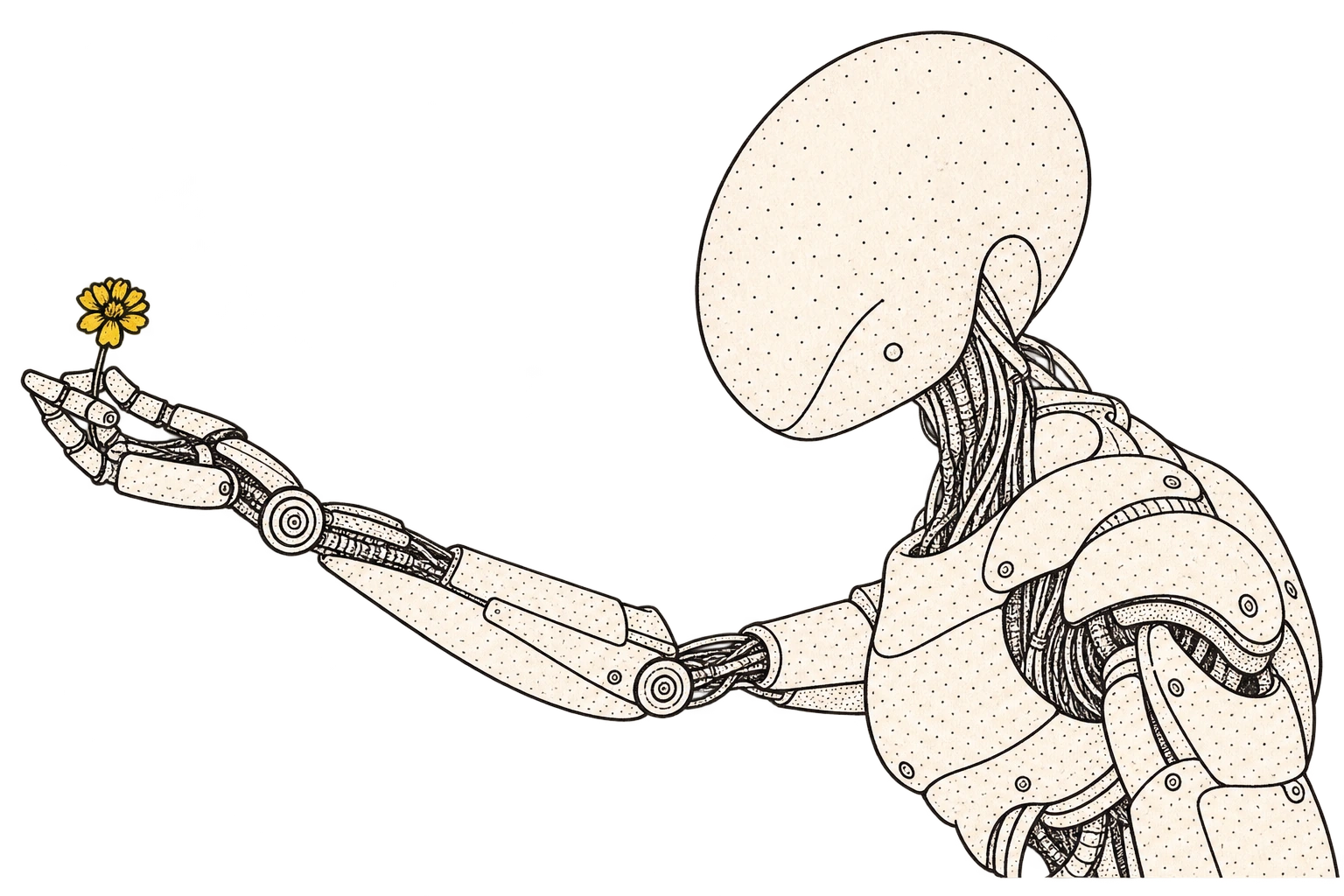
Praise for the book
“Artificial Intelligence has handed cyber adversaries the tools to attack faster than we can respond. Chris breaks down the pieces of the attack that actually matter, and what we should really be focusing on — with the data to back it up.”
The method
Three verbs turn a threat into a response: Sense, Decide, Contain. Each one has to arrive in time.
Time-to-Good-Decision connects the whole path: detecting a threat, deciding what to do, and executing the response. The goal is to shorten that path so action arrives before impact.
Recognize progression early
Detection earns its value through what it makes possible next. The useful signal is the one that reaches a person or system with the context to act.
How early can we see progression—and who receives that signal?
Make judgment operational
A response needs a clear purpose, sufficient context, and someone with the authority to make the call. Examine what must happen between recognizing a threat and authorizing action.
Who can make the call, and what do they need to know?
Change the trajectory
The decision must become an effective, bounded action. People, systems, and shared architecture determine how quickly a response can reach the place it is needed.
Can the action arrive in time—and can we see whether it worked?
Some chains are aimed at you.
Others you inherited.
They break in the same place.
Break the Chain · Chris Perkins
The author
Cybersecurity architect · Writer
Las Cruces, New Mexico

Keep the connection
Get an email when the book is available, or request an invitation to the Discord community.